
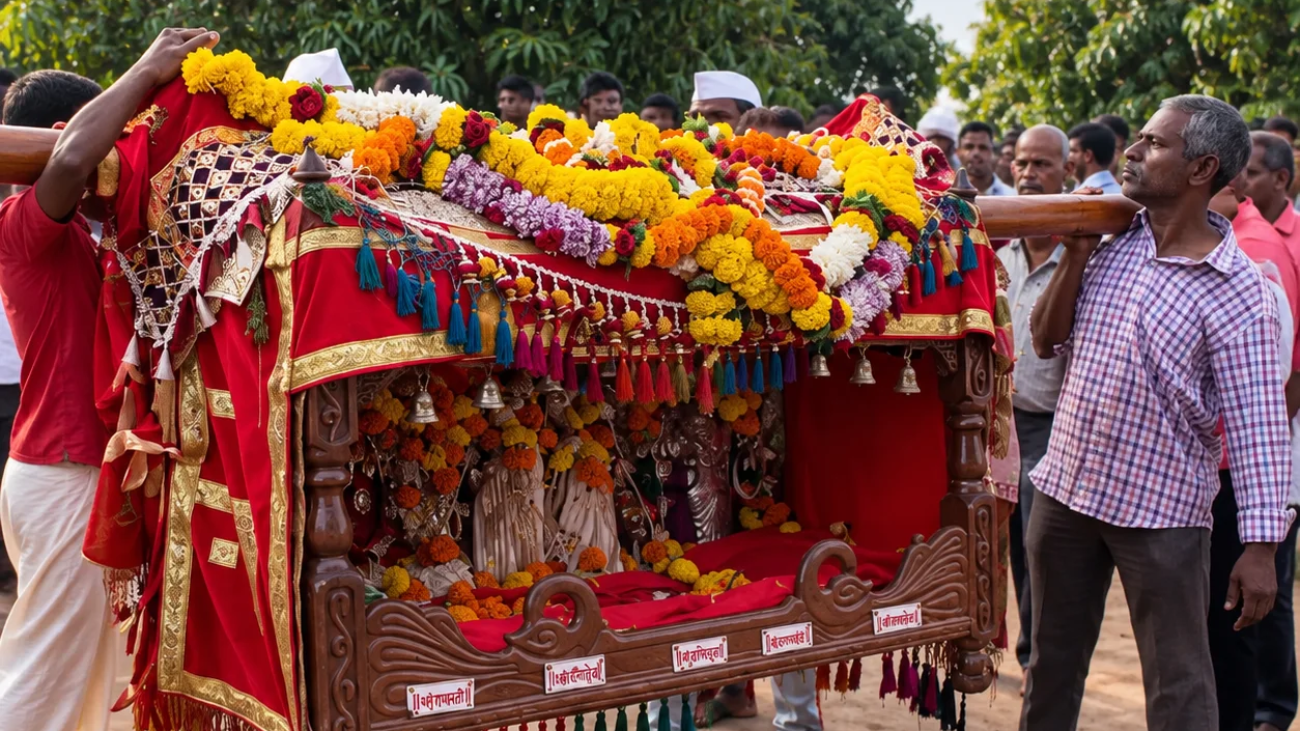
Elsewhere in India, Holi is an afternoon. In the Konkan it is a fortnight, it is called Shimga, and it belongs to the villages rather than to the towns. If you are in Dapoli in late February or March you will hear it before you see it: drums, from somewhere down the valley, going on far longer than you expect.
What Shimga actually is
Shimga is the Konkan’s spring festival, held over the days around the full moon of Phalgun. At its centre is the gram devata — the village deity — who is brought out of the temple, placed in an ornately carved wooden palanquin called a palkhi, and carried in procession from hamlet to hamlet. Each village has its own deity, its own palkhi, its own route and its own order of precedence, and these are not details anybody treats lightly.
The palkhi does not simply travel. It is danced. The bearers move it in time to the drums, and a good set of bearers can make several hundred kilos of carved teak look weightless — swinging, turning, dipping at the door of each house that has come out to receive the deity. Families wait at their thresholds with lamps and offerings. The procession may reach a village at two in the morning and be received exactly as warmly as it would at noon.
The sound of it
Two instruments carry the whole festival. The dhol is the big double-headed drum that sets the pulse, and the tasha is the sharp, high, metal-bodied drum that plays against it. Played together by a village troupe who have been practising since January, they produce a pattern that is genuinely difficult to walk away from.
Alongside the procession come the folk forms the Konkan keeps alive largely through this festival — Naman, Jakhadi, Gomu, and the masked and painted performers who move ahead of the palkhi. Much of this is performed by people who farm or fish for the rest of the year.
Watching respectfully
Shimga is a religious observance that visitors are welcome at, not a show staged for them. A few things worth knowing:
- Ask before photographing — the deity, the palkhi and the bearers especially. Almost everyone says yes. Asking is the point.
- Do not step in front of a moving palkhi. It weighs a great deal, the bearers cannot stop quickly, and the route belongs to the procession.
- Follow the crowd on footwear. Shoes come off where the deity is received.
- Colour comes at the end. The playing with colour that outsiders associate with Holi happens on Rang Panchami, five days after the full moon — not throughout.
Seeing it from here
The villages around Dapoli each hold their own Shimga, and the dates shift by a day or two between them, which means that over a stay of three or four nights you can usually catch more than one. We know when the local processions are going out and roughly where they will be after dark, and we can tell you which are the easiest to reach and where to leave a car.
Come for four nights around the full moon of Phalgun — in most years that falls in the first half of March. Nights run late, so plan on slow mornings.