
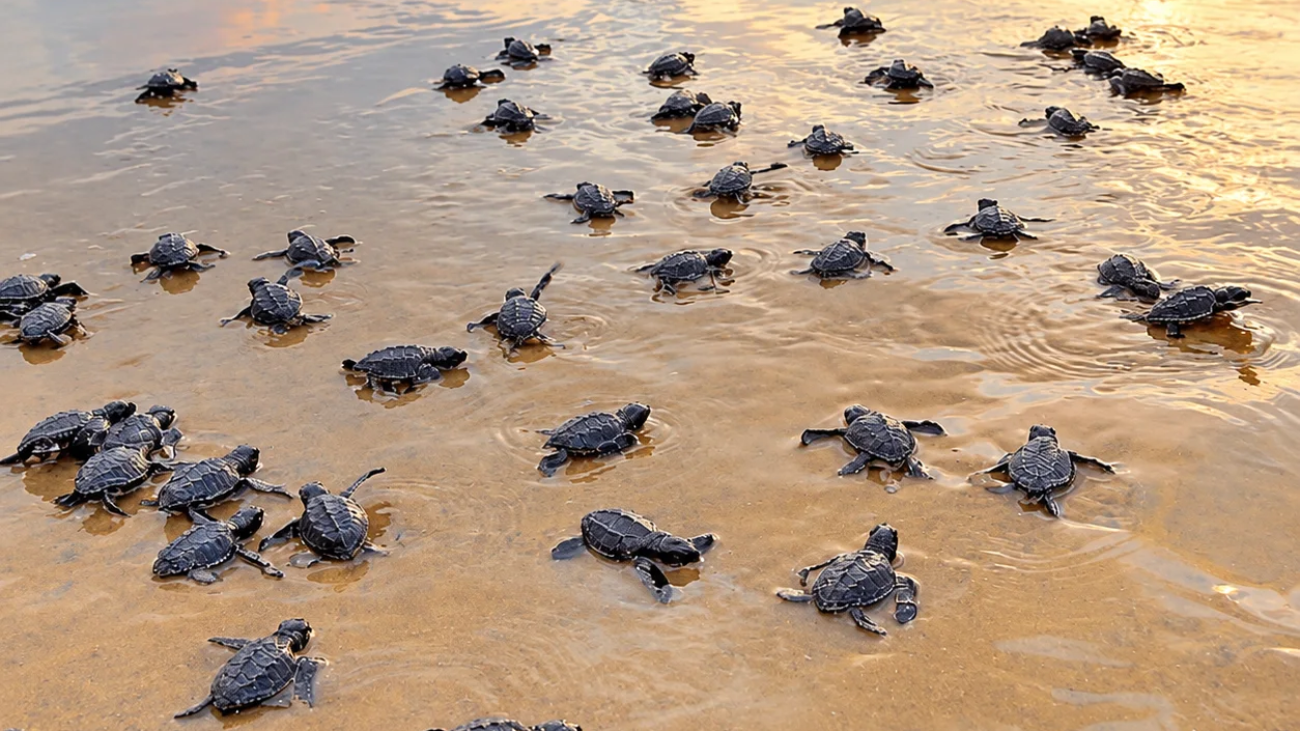
Some time between the end of January and the middle of April, on two beaches within reach of Dapoli, a few dozen people stand in a loose semicircle on the sand at first light and watch something the size of a matchbox make its way to the sea. The Olive Ridley hatchlings at Velas and Anjarle are the smallest wildlife spectacle on this coast and, for most people who see it, the one they remember.
What is happening
Olive Ridleys are the smallest and most numerous of the sea turtles, and the females return to nest on the beach where they themselves hatched. A female comes ashore at night, digs a chamber above the tide line, lays somewhere between a hundred and a hundred and fifty eggs, covers them, and goes back into the water. She does not return.
About seven weeks later the eggs hatch, all at once, and the hatchlings dig upward and run for the sea. Very few survive to adulthood — the usual estimate is around one in a thousand. Those that do will not be seen again for years.
Why these two beaches
Velas and Anjarle both run a nest-protection programme that has been going since the early 2000s. Local volunteers find the nests the night they are laid, move the eggs into a fenced hatchery above the high-water mark, and guard them until they hatch — protection against dogs, jackals, tide and poaching, all of which used to take the great majority of a season’s eggs.
When a nest hatches, the hatchlings are released at sunrise or sunset, in front of whoever is there to watch. The releases are announced a day or two ahead at most, because nobody can predict a hatch precisely. That uncertainty is the whole character of the trip: you come for the chance of it, not the certainty.
Going to see it
- Velas is about two hours north of Dapoli by road, and holds a turtle festival each season with homestays run by the village.
- Anjarle is much closer — around 45 minutes — and quieter, with the Kadyavarcha Ganpati temple on the headland above the beach worth the trip by itself.
- The season runs roughly from February to the middle of April. Late February and March are the likeliest weeks.
- Releases are at sunrise and sunset. A sunrise release means leaving here in the dark.
The rules, and why they matter
The volunteers will brief you, and the rules are not decoration. Hatchlings orient themselves by the brightness of the horizon over the water, so any light behind them sends them the wrong way.
- No flash, no torches, no phone lights on the beach during a release.
- Stay behind the line the volunteers mark, and never between a hatchling and the sea.
- Do not pick one up or carry one to the water. The crawl down the beach is how it takes its bearings, and it is not there to be helped.
- Keep back and keep quiet. The whole thing takes fifteen or twenty minutes.
Planning it from here
We watch the season and can tell you what has hatched recently and whether a release is likely while you are with us. Nobody can promise one — that is the honest position, and any operator who promises it is guessing. What we can do is get you there at the right hour with the right directions, and make sure you are not the person on the beach with a torch.